
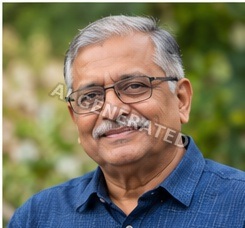
Social Educator and Community Leader
T. Gopalakrishnan
Social Educator and Community Leader
T. Gopalakrishnan first came to the fictional Sree Narayana Community Development Council (SNCDC) as a volunteer at the local level. He would later be elected its president. Between those two points lies the story of an organisation that grew from a small community initiative into a body working across education, social welfare and community development — and of a man who, in recent years, has turned his attention to who will carry that work forward.
Fictional demonstration profile — created to show how a Jannayaks profile reads. It does not describe a real person.
Biography
Social Educator and Community LeaderT. Gopalakrishnan first came to the fictional Sree Narayana Community Development Council (SNCDC) as a volunteer at the local level. He would later be elected its president. Between those two points lies the story of an organisation that grew from a small community initiative into a body working across education, social welfare and community development — and of a man who, in recent years, has turned his attention to who will carry that work forward.
He was born in Alappuzha and studied history at the University of Kerala. His working life began not in community work but in the cooperative sector, where he spent several years in banking. His involvement with community organisations came later, and it began modestly, with volunteer work supporting educational programmes for young people.
The SNCDC had originally been established to support educational and social development programmes among members of the community. Gopalakrishnan’s association with it began at the local level, and with a practical task: helping to organise scholarship assistance for students from economically weaker families.
What began as a volunteer activity gradually became a larger responsibility. He served in turn as branch secretary, district coordinator and state education convenor, each role widening the part of the organisation’s work for which he was answerable, before being elected president of the SNCDC. As president, he oversaw the expansion of existing programmes and the introduction of new initiatives in vocational education, women’s self-help groups and youth development.
Education has remained one of his principal interests, and the scholarship programme offers perhaps the clearest measure of how the work grew. When it began, it assisted fewer than fifty students; it eventually reached several hundred. Gopalakrishnan also supported the creation of a vocational training centre, intended to give practical skills to young people who had not pursued conventional higher education.
Among the initiatives of those years, one he considers particularly meaningful is a women’s micro-enterprise programme. Small groups of women received training and modest financial assistance to establish home-based businesses, and over time the programme developed into a network of women’s self-help groups operating in several districts.
The programme also reflects what he believes community work is for. For Gopalakrishnan, its purpose is not simply to provide assistance. He believes that people who receive support should eventually become participants in creating opportunities for others, and that a community organisation becomes sustainable only when that happens.
The same conviction has shaped the organisation’s youth programmes. Young volunteers are given responsibility for educational camps, cultural programmes and community service activities, while senior office-bearers act increasingly as mentors rather than permanent organisers. The arrangement asks experienced members to step back as much as it asks younger ones to step forward.
Leadership has also called for balance. His approach has sometimes required him to weigh the expectations of a large membership against the practical limitations of an organisation dependent on volunteers and donations. His work has meant dealing, too, with people holding different public viewpoints. He has maintained that the SNCDC’s community programmes should remain accessible to people of different affiliations and backgrounds, while he has himself spoken publicly, from time to time, on issues involving education, social mobility, representation and access to public institutions.
Over the years his responsibilities have included the presidency of the SNCDC, the chairmanship of its Education Committee, the convenorship of its Community Development Programme and membership of the governing board of the organisation’s educational trust. He has also served on advisory committees connected with vocational education and community development.
Away from the organisation, Gopalakrishnan leads a comparatively ordinary family life. His wife, Radha, is a retired teacher, and their two children work in medicine and education. He remains interested in books and classical Malayalam literature, and in conversations with young people entering professional life — an interest that sits naturally beside his work with the organisation’s young volunteers.
At an age when many people begin to reduce their responsibilities, he has instead become increasingly interested in succession. He wants the SNCDC to become less dependent on individual leaders and more capable of producing its next generation of volunteers, educators and community organisers.
He sees a continuity between where he began and where he has arrived. He started by helping a small number of students obtain educational assistance; he later found himself responsible for an institution working across several areas of community life. To him, the two stages belong together. The purpose of an organisation, he believes, is not merely to solve today’s problems, but to leave behind people capable of solving tomorrow’s.
Profile reference · JN-GAPUJ